
What if the best performance upgrade isn’t the one that adds the most power? Choosing a performance car specialist Berkshire drivers can trust means looking beyond headline gains to how the work suits the car and the way you use it.
It’s natural to want sharper response or a more engaging drive while protecting your car’s reliability, road use and insurance position. Start with the vehicle, its condition and your priorities, rather than a one-size-fits-all modification. Being clear about these details makes it easier to weigh up the work and its practical implications.
This guide explains what a performance car specialist can help with, how to assess a proposed project and what to prepare before discussing work. At LA Car Hub in Reading, performance upgrades and tuning sit alongside accident repairs, spray painting, alloy refurbishment and detailing. You’ll find practical ways to make a considered decision for your car and intended use.
Key Takeaways
- A performance car specialist Berkshire drivers consider should match the work to the vehicle, its condition and its intended use.
- Look for a clear technical approach that explains the proposed work, its scope and the trade-offs involved.
- Use your priorities, such as response, handling, comfort or everyday practicality, to shape a realistic project discussion.
- Prepare your vehicle details, maintenance history, existing modifications and typical driving use before planning work.
- LA Car Hub brings performance upgrades and tuning together with practical repair and cosmetic services in Reading.
What a performance car specialist in Berkshire can help you achieve
“Performance specialist” can mean different things. One driver may want sharper throttle response, another a more settled feel through corners, while someone else may be considering a high-performance car purchase. The term describes an area of expertise, not one standard service or type of vehicle.
A performance car specialist matches suitable work to the car’s condition and how its owner intends to use it. That means understanding the goal before recommending a modification. A performance car specialist Berkshire drivers speak to should consider the wider project, rather than treating one product or upgrade as the answer for every vehicle.
Performance cars span a range of designs and capabilities. The overview of What is a Performance Car? offers useful context, but the practical question is what you want your own car to do. Tuning and upgrades are distinct from accident repairs, spray painting, alloy refurbishment, detailing and vehicle sales. These services can sit within the same automotive business, but each addresses a different need.
What kinds of performance work might a driver consider?
Projects can involve engine tuning, suspension components or other mechanical upgrades. These aren’t interchangeable: tuning focuses on engine response, while suspension work relates to how the car behaves on the road. The right direction depends on the vehicle, its condition and your priorities. Without a vehicle-specific assessment, it isn’t sensible to promise a particular gain or assume a component will suit.
Start by describing what you want to feel differently. Is the car slow to respond, uncomfortable on everyday journeys or less composed than you’d like? A clear objective gives the discussion direction and helps identify appropriate work, including whether the car needs attention before performance changes are considered.
Why intended use matters before choosing a direction
A car used for commuting and regular road journeys has different demands from one enjoyed mainly at weekends or taken to a track occasionally. None of these uses automatically calls for a particular setup. They simply affect the balance you may want between comfort, handling, reliability and everyday practicality.
- Everyday road use: Consider how the car behaves in traffic, on longer journeys and over uneven roads.
- Weekend enjoyment: Decide which parts of the drive you most want to improve, without overlooking routine usability.
- Occasional track use: Explain how often you’ll use the car this way and what you expect from it, alongside its road use.
These are starting points for a conversation, not prescriptions. A change that suits one driver may be uncomfortable or impractical for another, particularly if the vehicle has existing wear or modifications. For more help setting priorities, the performance upgrades guide for Reading explains how to think through a project before deciding on the work.
How to assess a performance car specialist’s technical approach
A considered project starts with questions, not a pre-selected modification. A specialist should understand your car, what you want to change and how you use it. They should then explain the proposed work in plain language, including its scope and any factors that could affect the plan.
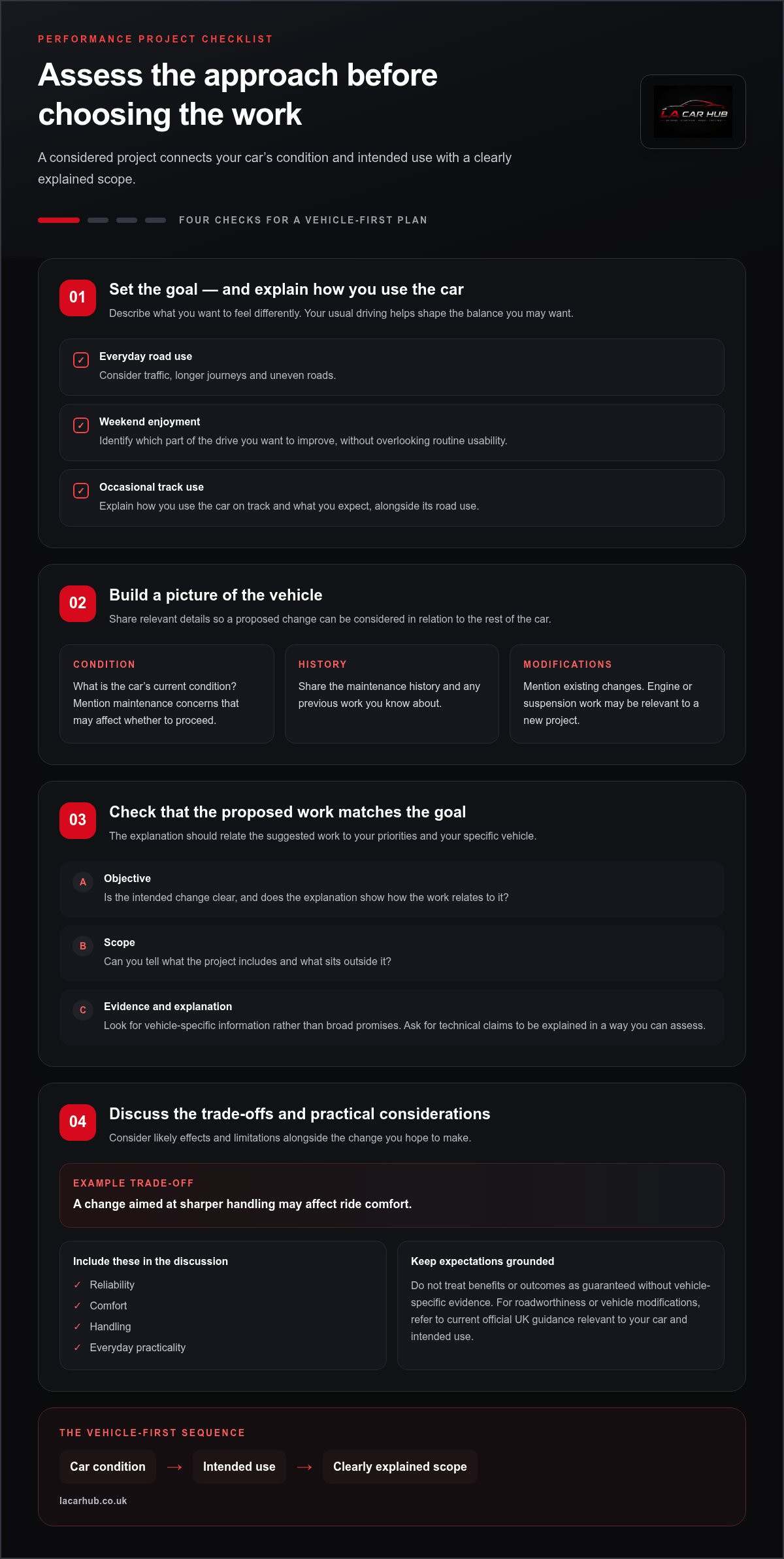
Good project planning connects the car’s condition and intended use with a clearly explained scope of work. Notice whether the discussion covers trade-offs. For example, a change aimed at sharper handling may affect ride comfort. The proposal should relate to your priorities, not focus only on potential benefits.
Clear communication is useful, but it isn’t proof of technical capability by itself. Look for explanations specific to your vehicle and supported by relevant information, rather than broad promises. If a technical claim matters to your decision, ask for an explanation you can understand and assess.
What a vehicle-first assessment should take into account
Relevant context can include the vehicle’s current condition, maintenance history and existing modifications. Share what you know, including previous work that may affect the area you want to change. The information needed varies by project. The aim is to consider an upgrade in relation to the rest of the vehicle, rather than in isolation.
For example, existing engine or suspension changes may be relevant to a new tuning or handling project. Maintenance concerns could also affect whether it makes sense to proceed. A useful discussion connects these details to the proposed scope instead of relying on assumptions.
How to understand the proposed work and its trade-offs
Compare the stated objective with the work being suggested. If you want more responsive driving, does the explanation show how the proposed work relates to that aim? Ask what the project includes, what it doesn’t and which practical considerations matter for your car. Reliability, comfort, handling and daily usability are all worth discussing. Don’t treat them as guaranteed outcomes without vehicle-specific evidence.
- Objective: Is the intended change described clearly?
- Scope: Can you tell what work is proposed and what sits outside it?
- Trade-offs: Have practical effects and limitations been discussed alongside the hoped-for change?
For tuning projects, a car tuning guide for Reading can help you frame questions and compare an upgrade’s purpose with your priorities. For roadworthiness or vehicle modifications, consult current official UK guidance relevant to your car and intended use, rather than relying on general advice from overseas sources.
If you’re considering performance upgrades or tuning in Reading, explore LA Car Hub’s automotive services as you shape your project and clarify what matters to you.
Performance upgrades in Berkshire: matching the project to your car
A longer list of modifications doesn’t automatically make a better car. A worthwhile project serves a clear purpose, suits the vehicle and fits the way you’ll use it. Consider each change in the context of the whole car, rather than assuming that more work means a better result.
Use this table as a discussion framework, not a promise of specific results. Technical examples need to be checked against your vehicle, its condition and the work proposed.
| Priority | What to discuss |
|---|---|
| Response | Whether tuning could address how the car responds to the driver’s inputs. Suitability and outcome need vehicle-specific assessment. |
| Handling | Whether suspension components or other changes relate to how the car feels through corners. Compatibility and setup require specialist verification. |
| Comfort | How proposed changes may affect ride feel on the roads you regularly use. |
| Appearance | Whether cosmetic work, such as refinishing, suits the look you want without confusing appearance changes with mechanical upgrades. |
| Everyday practicality | How the project fits your regular journeys, maintenance expectations and plans for the car. |
Tuning, suspension and other modifications serve different aims
Tuning, suspension changes and broader aftermarket modifications aren’t interchangeable. Tuning relates to how the vehicle’s engine is managed; suspension work concerns components that influence its behaviour and ride. Other modifications may serve different purposes. A driver prioritising performance feel may want something different from someone focused on handling balance or practical road use. A performance car specialist berkshire drivers consider should connect the proposed work to the aim without presenting an unverified result as certain.
If handling is your focus, the suspension upgrades guide for Reading can help you consider what to discuss. Component compatibility and any supporting work need to be assessed for your particular car. Keep decisions grounded in the vehicle’s needs and the conditions in which it will be driven, rather than broad claims about automotive trends.
Balancing performance goals with road use and ownership
Think beyond the first drive after the work. Comfort on regular journeys, maintenance expectations and how long you plan to keep the car can all influence what feels worthwhile. A setup intended for occasional track use may involve different compromises from one chosen for regular road driving. Neither is automatically right for every owner or vehicle.
Before deciding, review your insurer’s requirements and any relevant warranty terms, and check current official UK guidance on roadworthiness and vehicle changes. Don’t assume a modification is automatically covered by insurance, suitable for road use or compatible with a warranty. Understanding the proposed work and its practical implications gives you a sounder basis for deciding whether it fits your car and ownership plans.
A practical checklist before planning performance work in Berkshire
Some preparation makes it easier to explain what you want and gives the project discussion a useful starting point. You don’t need to know the technical answer in advance. Clear notes about your car, its history and how you use it help a performance car specialist Berkshire drivers consult understand your goals.
Information to gather about your car and intended use
Before discussing a project, gather the details you already have. Accuracy matters more than filling every gap. Use this checklist to organise your notes:
- Record the basics: Make, model, year and current mileage help identify the vehicle.
- Note maintenance and concerns: Include recent servicing or repairs, ongoing symptoms and issues you’d like addressed before considering upgrades.
- List existing modifications: Write down known changes, including work carried out by previous owners. Add dates or paperwork if available.
- Describe how you drive: Note whether the car is mainly used for commuting, longer road journeys, weekend enjoyment or occasional track use.
- Set your priorities: Pick the change you value most, then note what you don’t want to compromise, such as comfort, everyday usability or reliability.
- Gather supporting records: Service documents, invoices and clear photographs can help explain previous work or the vehicle’s current condition.
You don’t need specialist vocabulary. “The ride feels unsettled on rough roads” or “I’d like the car to respond more promptly” is a useful starting point. Describe what you’ve noticed and let the technical discussion build from there.
How to compare project options without chasing headline figures
Compare each option with your stated goals, not just a headline performance claim. Ask whether the proposed work addresses the change you want, what it includes and what compromises may come with it. A clear explanation should relate to your vehicle and intended use, rather than rely on broad claims that haven’t been verified for your car.
Keep your preferred outcome and acceptable trade-offs side by side. If everyday comfort matters as much as handling, for example, record both rather than treating one as an afterthought. A written scope also helps distinguish work included in a proposal from ideas that might be considered separately. The aftermarket modifications checklist for Reading offers another way to think through changes intended for a road car.
Before committing, review your insurer’s requirements, any relevant warranty terms and current official UK guidance on roadworthiness. Requirements and policy conditions depend on the circumstances, so don’t assume a modification is automatically covered or suitable for road use.
Bring your notes to discuss performance upgrades and tuning with LA Car Hub in Reading.
Finding performance car expertise in Reading with LA Car Hub
For Berkshire drivers considering performance work, a local centre that also handles other vehicle needs can be a useful point of contact. LA Car Hub is a Reading-based automotive centre offering performance upgrades and tuning, as well as accident repairs, spray painting, alloy refurbishment and detailing. It also sells high-performance vehicles.
These services meet different needs. Upgrades and tuning focus on changing aspects of a car’s performance; accident repairs and spray painting address damage and bodywork; alloy refurbishment and detailing relate to presentation. A car might need attention after damage, a cosmetic refresh or a performance project as its owner’s priorities change.
A local automotive centre for performance and practical needs
Considering performance, repair and cosmetic needs together can help owners think about the vehicle as a whole. Someone may first be interested in tuning, then later need accident repairs or alloy refurbishment. These are distinct services, but they all relate to the same car. LA Car Hub brings them together at its Reading automotive centre, with each service addressing its own purpose.
Drivers can discuss performance upgrades and tuning in person while considering the car’s wider needs. The right project still depends on the vehicle and the owner’s aims. Start by describing what you’d like to change, alongside any practical repair or presentation work you have in mind.
A straightforward next step for Berkshire drivers
You don’t need to arrive with technical answers. Bring the details that help describe your car: its make and model, year, mileage, known modifications and relevant maintenance or repair history. Explain how you normally use it, what you’d like to improve and what matters just as much, such as comfort or everyday practicality. Photos or records can help show previous work or the vehicle’s current condition.
This gives the conversation a useful direction, whether you’re exploring tuning, considering another upgrade or weighing performance work alongside a repair or cosmetic requirement. Focus on the reason for the work and how it fits your ownership, rather than feeling you need a fully formed technical plan. A performance car specialist Berkshire drivers approach should make it easier to discuss the vehicle and your goals in straightforward terms.
LA Car Hub brings performance upgrades and tuning together with accident repairs, spray painting, alloy refurbishment and detailing in Reading. Explore LA Car Hub’s services and discuss your plans for your vehicle.
Take the next step at your own pace
A worthwhile project doesn’t need to start with a long list of modifications. Begin with one clear question: what would make your car better suited to the way you want to drive it? That gives you a practical starting point for weighing options, discussing compromises and deciding what feels right for your vehicle.
Choosing a performance car specialist berkshire drivers can talk to is part of making that decision with care. Explore the work available at LA Car Hub, where performance upgrades and tuning sit alongside repair and presentation services.
Explore performance upgrades and automotive services at LA Car Hub and discuss your plans for your car in Reading.
Frequently Asked Questions
Can performance upgrades make a car less comfortable for everyday driving?
They can, but the effect depends on the vehicle, the upgrade and how you use the car. Some changes may alter ride firmness, noise or the feel on familiar roads; other projects may aim to balance performance with usability. Consider your regular journeys, including traffic and rough road surfaces, and weigh comfort alongside your performance goals. Discuss the specific trade-offs for your vehicle before settling on a plan.
Does modifying a car automatically invalidate its manufacturer warranty?
No, a modification doesn’t automatically invalidate every manufacturer warranty. The implications can depend on the vehicle, warranty terms, work carried out and whether a later fault is related to that work. Before proceeding, read your car’s warranty documents and seek current, vehicle-specific information about how the proposed change may be treated. Keep this question separate from insurance and roadworthiness, which involve different considerations.
Do I need to tell my insurer about performance modifications?
Review your policy and your insurer’s current requirements before making changes. Insurers may set different conditions, so don’t assume the rules or notification process are the same across policies. Failing to meet the conditions that apply to your cover can cause problems if you later need to make a claim. Check your policy documents and speak to your insurer about the proposed modification to understand how it affects your vehicle.
Can performance modifications affect a car’s MOT?
They can be relevant, but modifications don’t all affect an MOT in the same way. A vehicle must meet applicable roadworthiness requirements when tested, and the condition and installation of changed components may matter. Check current DVSA information before relying on general advice about a particular modification. No upgrade or repair guarantees a pass, so keep the vehicle’s overall condition in mind.
Can performance upgrades be reversed later?
That depends on the components used, how they’re installed and whether the original vehicle has been changed. Some parts may be removable, while other work could leave alterations that are difficult or impractical to undo. If you may sell the car or return it to a previous setup, include that in the project discussion. Keep records of the work and don’t assume an upgrade can be returned to factory condition.
What records should I keep after performance work?
Keep invoices, descriptions of fitted parts, installation records and relevant maintenance or inspection information with the car’s service history. This creates a clearer record of what changed and when, and can help you share accurate details during future servicing, insurance discussions or a sale. Documentation doesn’t guarantee insurance cover, resale value or compliance, but organised records make the vehicle’s history easier to explain.


