
The most powerful hot hatch on your shortlist may be the least satisfying one to live with. When comparing hot hatches for sale Reading has to offer, everyday comfort, running costs and condition matter as much as pace. A car that feels exciting on a test drive still needs to suit your regular journeys and practical needs.
It’s easy to focus on specifications and miss signs of hard use, undocumented repairs or modifications. This checklist will help you build a realistic shortlist, review service history and condition, and prepare for a viewing. We’ll cover how to compare specifications, what to look for during an inspection, and how to weigh performance against day-to-day practicality. You’ll also find guidance on next steps, including browsing performance-focused used cars at LA Car Hub’s Green Lane showroom, discussing a part exchange and exploring third-party finance options.
Key Takeaways
- Match the engine, gearbox and equipment to your regular journeys, not just the headline performance figures.
- Compare hot hatches for sale Reading has to offer by checking the evidence behind each car’s history and condition, not relying on mileage or appearance alone.
- Use a consistent viewing and test-drive routine to spot details that may need a closer look.
- Compare the vehicle, its listing and its paperwork before deciding whether it belongs on your shortlist.
- Once you’ve found a suitable car, consider the next steps, including a part exchange or third-party finance.
Hot hatches in Reading: right for your daily drive?
Choosing a hot hatch means balancing responsive performance with the realities of everyday use. You might want something engaging on an open stretch, but it also needs to manage weekday journeys, passengers and the weekly shop. A search for “hot hatches for sale reading” is a useful starting point. The right choice depends on how you’ll use the car and its individual condition.
A hot hatch is a compact hatchback with a performance-focused engine or chassis. Its rear hatch and practical cabin are paired with a more focused driving character. For a plain overview of the category and its history, see What is a Hot Hatch?
Compared with a larger performance car, a hatchback may be easier to place in tighter parking spaces and more convenient for regular errands. Rear doors and a hatch can also make passenger access and loading simpler than in a two-door sports car. But not every hot hatch is spacious or comfortable. Cabin layout, boot space, ride quality and performance vary, so assess the individual car against your needs.
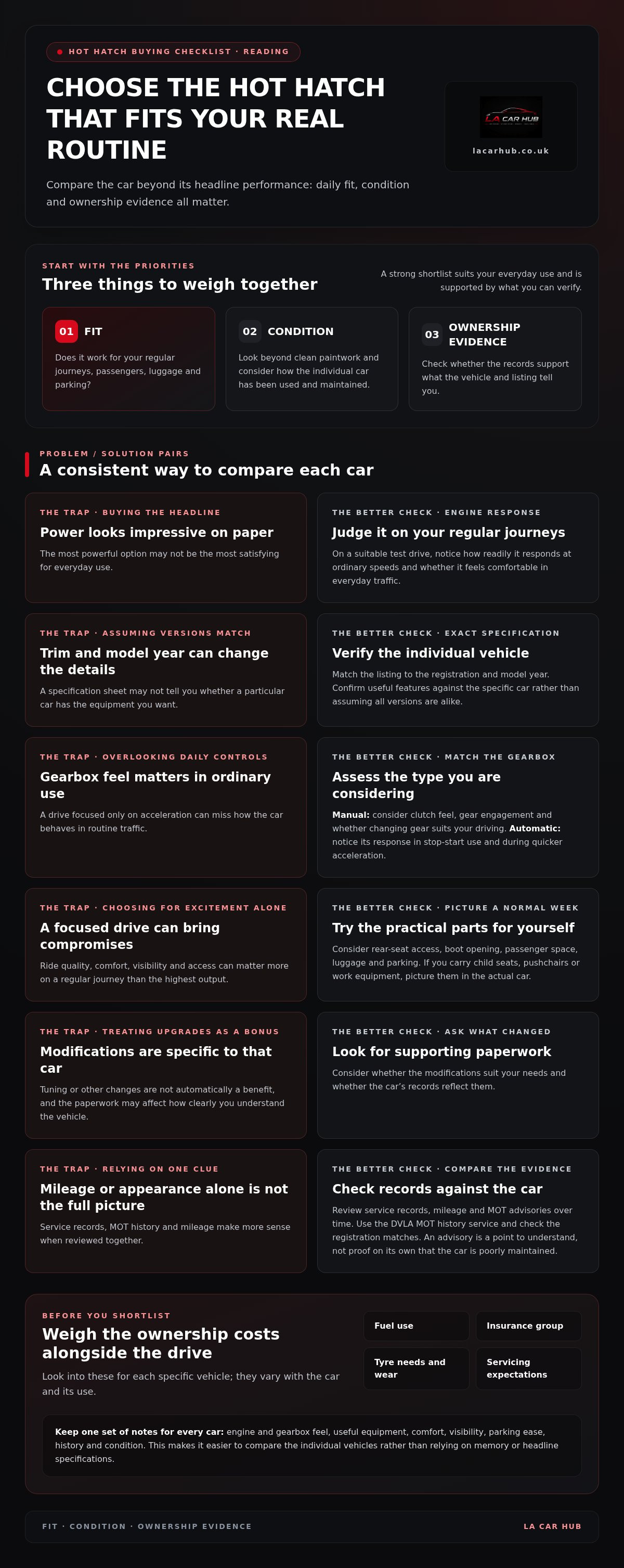
Fit, condition and ownership evidence are the three priorities for choosing a hot hatch as a daily car. Fit means it works for your routine, not just your ideal drive. Condition means looking beyond clean paintwork. Ownership evidence helps you understand how the car has been maintained and whether its history supports what you see.
What makes a hot hatch a practical performance car?
Hatchback packaging can bring useful flexibility without the footprint of a larger performance car. Think through a normal week around Reading: how often will you carry passengers, load bulky shopping or park in a confined space? Check rear-seat access and the boot opening, not just the stated capacity. If you regularly carry child seats, pushchairs or work equipment, picture them in the actual car rather than assuming the hatchback shape will be enough.
Which compromises should you consider before viewing?
Performance can come with a firmer ride. Tyre wear also depends on the car’s use, set-up and maintenance. Fuel use and insurance group affect ownership too, so look into both for each specific vehicle before settling on a shortlist. Separate essentials, such as comfortable passenger space, from features that mainly add driving excitement. Prioritise cars that suit your regular journeys, passengers and luggage, then weigh performance equipment against those everyday requirements.
Be specific about what you can live with. If most journeys are short and practical, comfort, visibility and easy access may matter more than the highest output. If you often travel with passengers, check whether the rear seats are genuinely usable for them. A well-matched shortlist makes it easier to compare individual cars instead of being drawn in by a specification that doesn’t suit your routine.
A hot hatch buying checklist: match specification to your needs
Once you know what your daily routine requires, compare each car against the same points. A tidy specification sheet can make a car look ideal, but what matters is how it drives, what equipment it has and whether its ownership record gives you confidence.
The right specification is the one that fits your real routine. Use this checklist for every car you shortlist, and note differences as you go rather than relying on memory.
- Check the exact model and specification. Match the listing to the vehicle’s registration and model year. Equipment can change between years and trims, so check the individual listing for the features that matter to you instead of assuming all versions are alike.
- Compare engine response. Consider whether the power delivery feels manageable and useful on your regular journeys, not just impressive on paper. During a suitable test drive, notice how readily the car responds at ordinary speeds and whether it feels comfortable in everyday traffic.
- Assess the gearbox. In a manual, consider clutch feel, gear engagement and whether changing gear suits your driving. In an automatic, pay attention to how smoothly it responds in normal stop-start use as well as when you ask for quicker acceleration.
- Prioritise useful equipment. Check visibility, seat comfort, parking aids and infotainment against your routine. A feature you’ll use every day may be more valuable than an optional performance extra you’ll rarely need.
- Understand any modifications. Treat upgrades or tuning as specific to that vehicle, not an automatic benefit. Ask what has been changed and look for supporting paperwork. Consider whether the changes suit your needs and whether the car’s records reflect them.
- Review the ownership picture. Compare service records, mileage and MOT history, including recorded advisories. Use the DVLA MOT history service and check that the registration matches the car you’re viewing. An advisory is a point to understand, not proof on its own that the car is poorly maintained.
Compare performance, gearbox and everyday equipment
Keep your notes practical. Record what you liked about the engine and gearbox, then weigh that against comfort, visibility and ease of parking. Equipment can vary with trim and model year, so verify it against the individual vehicle listing. For each feature, ask whether it solves a real need on your journeys or mainly adds appeal on paper.
Review the ownership picture before shortlisting
Service history, MOT records and mileage make more sense together than in isolation. Look for a clear record over time, note advisories and compare mileage in available records with the current reading. Then factor in insurance group, fuel requirements, tyre needs and servicing expectations. These checks help you judge whether the car fits your ownership plans, not just your test-drive impressions.
For a local comparison, browse performance-focused cars at LA Car Hub and apply the same checklist to each vehicle listing.
Compare hot hatches in Reading: condition, history and evidence
A clean cabin and low mileage can make a strong first impression, but neither tells the whole story. Compare each car using the same evidence, then note what you’ve seen and what remains unanswered. That gives you a fairer basis for comparing hot hatches for sale in Reading than relying on appearance or one figure on the dashboard.
Use this table during your research and viewing. Record evidence for each car so you can compare your shortlist accurately.
| Area | Evidence to compare | Question to resolve |
|---|---|---|
| History | MOT history, service records, invoices and mileage entries | Do dates and recorded mileage form a clear timeline? |
| Identity | Registration, vehicle identification number and V5C details | Do the vehicle details match across the car and paperwork? |
| Condition | Tyres, wheels, body panels, cabin wear and dashboard warnings | Are there signs that need explanation or closer inspection? |
| Equipment and changes | Listing, fitted equipment, modifications and related paperwork | Does the car match its description, and are changes documented? |
| Ownership | Servicing pattern, recorded advisories and answers to your questions | What is clear, and what still needs an answer before you decide? |
Check records and paperwork consistently
Compare the MOT history with service invoices and any mileage records. Check that the registration and vehicle identification details correspond with the car, and compare the V5C details with the vehicle. A missing invoice or unexplained gap is an unanswered question, not proof of a fault. MOT history adds useful context, but it isn’t a complete service record or a substitute for examining the car in person.
Look for signs of use, repair or modification
During the viewing, check the tyres and wheels, look over the panels in good light, and compare cabin wear with the mileage and history. Notice any dashboard warning lights and make a note of concerns to discuss. If modifications are fitted, find out what has changed and look for supporting paperwork. For background on assessing changes, see this performance upgrades guide for Reading.
Keep the comparison balanced. A worn steering wheel or scuffed alloy may reflect ordinary use, while polished paintwork doesn’t establish mechanical condition. Consider each observation alongside the records and the seller’s explanation. Write down questions for every car, then compare the answers for clarity and consistency. If a detail can’t be reconciled, mark it as unresolved rather than filling the gap with an assumption.
Evidence is most useful when it agrees across sources. For example, compare a mileage entry on an invoice with the MOT record and the current reading. A difference deserves clarification, but don’t jump to a conclusion before understanding the dates and context. This helps you distinguish a documented ownership picture from one that simply looks reassuring at first glance.
Viewing a hot hatch in Reading: a practical test-drive checklist
A viewing is your chance to see whether a car matches its listing and feels right beyond the photographs. Use a steady process: prepare first, inspect the vehicle, check how it starts, then assess it on a suitable test drive. When viewing hot hatches for sale in Reading, use the same steps for each car so you can compare observations afterwards instead of relying on first impressions.
- Prepare before you arrive. Bring your shortlist notes and review the vehicle’s listing, specification and available paperwork beforehand. Allow enough time to look over the car without rushing. Arrange the test drive with the seller, and only drive when the required permission and insurance arrangements are in place. You’ll need an appropriate driving licence, and should follow the Highway Code and all road rules.
- Walk round the car carefully. Check the vehicle in good light. Look along the body panels for differences in paint colour, finish or alignment, and inspect the glass, wheels and visible tyre condition. Open the doors and boot, then check for cabin wear or damage that seems inconsistent with the listing or the car’s recorded use. Compare the actual equipment and vehicle details with the advert and documents. Note anything you’d like explained.
- Pay attention at start-up. Notice whether the car starts cleanly and whether any warning lights remain illuminated. Listen for unfamiliar noises and observe the dashboard before setting off. Don’t try to diagnose a sound or warning yourself. Record what you notice and raise it with the seller. If the car is already running when you arrive, ask to see it start as part of your assessment.
- Use the drive to assess normal behaviour. Follow the agreed route and drive within your ability and the conditions. Consider how the clutch or automatic gearbox operates, whether the steering feels consistent, and how the brakes respond during ordinary use. Notice vibrations, noises or handling that feels unfamiliar. Test everyday functions, such as visibility and parking aids, where it’s safe to do so. Avoid hard acceleration or testing limits on public roads.
A test drive shows how a car behaves on the road, but it isn’t a full mechanical inspection. Treat it as one part of your decision, alongside the vehicle’s condition, history and paperwork. It can reveal things worth discussing, but it can’t establish the cause of every noise or vibration.
Once you’re back, write down what felt reassuring and what needs clarification while the details are fresh. Raise relevant points before deciding whether to proceed, and compare the seller’s answers with the listing and records. A calm, consistent explanation helps you judge the complete picture, but an observation alone isn’t proof of a fault.
Ready to put your checklist into practice? Browse performance-focused cars at LA Car Hub and compare the vehicle details before arranging your next step.
Buying a hot hatch from LA Car Hub: sensible next steps
Once you’ve compared your shortlist, make the next move at a pace that feels right. A search for hot hatches for sale reading can bring up different specifications and histories, so keep your notes handy and focus on the individual car. LA Car Hub sells pre-owned high-performance and prestige vehicles from its Green Lane showroom in Reading.
Arrange a viewing and discuss your purchase
Browse the current listings and choose a vehicle that matches the needs you’ve already set out. Before viewing, compare the listing with the car and its paperwork. Check that key details, such as registration, mileage, specification and listed equipment, line up. Make a note of any differences and discuss them before progressing.
A showroom visit lets you see the car in person and continue your assessment at a considered pace. Bring your questions and viewing notes, including anything you want to revisit from the history or test drive. If you have a car to part exchange, bring its details to the purchase discussion so it can be considered alongside your shortlisted vehicle.
Third-party dealer finance options are available as part of the purchase discussion. Finance arrangements are provided through a third party, so review the relevant terms and information carefully before deciding whether they suit your circumstances. No finance option should be treated as a promise of approval.
Make the decision with the evidence in front of you
Before committing, review the documents and purchase terms alongside your notes. Make sure you understand the vehicle being sold, the agreed details and any points discussed during the viewing. If a question remains unanswered, pause and get clarity before proceeding. Taking time to review the information is a sensible part of buying, not a sign that you’re uncertain about performance cars.
A practical plan keeps the decision straightforward:
- Bring your notes. Keep your condition, history and test-drive observations together, with any questions you want to raise.
- Compare the car with its listing. Revisit its identity, specification and equipment, and make sure the paperwork relates to the vehicle you’ve viewed.
- Discuss your options. Talk through the purchase, any part exchange and third-party dealer finance options as relevant to your plans.
- Review before proceeding. Read the vehicle documents and purchase terms carefully, and make your decision when the details are clear.
LA Car Hub offers a local place to explore performance-focused used cars and discuss purchase options. If you’re ready to take the next step, explore LA Car Hub to browse current listings or discuss buying, part exchange or finance.
Choose your next step with confidence
Searching for hot hatches for sale reading can turn up plenty to consider, but the best next step is to focus on a car that suits your real routine. Before you arrange a viewing, decide what would make you say yes and what would make you pause. That boundary can keep the process clear and help you take your time.
LA Car Hub brings over 10 years of operational experience to its automotive work. Use that experience as a starting point for an open conversation about the vehicle you’re considering, and weigh the details before making a commitment. The decision should feel considered, not hurried.
Ready to turn your shortlist into a viewing? Browse current stock and arrange a viewing at LA Car Hub. Bring your questions and use the preparation you’ve done to choose a car that suits you.
Frequently Asked Questions
What makes a car a hot hatch?
A hot hatch is a hatchback with a performance-focused engine or chassis, giving it a livelier character than a standard family hatch. The category covers a broad range: some cars prioritise quick acceleration, whilst others focus on handling or an engaging gearbox. Two cars with similar power can feel quite different to drive. Consider the overall character and specification, not just the badge or performance figures.
Are hot hatches practical enough for everyday driving?
Many can work well as everyday cars, but practicality depends on the particular model and your routine. A hatchback body may make loading shopping easier than a coupé, while rear-seat space and ride comfort still vary. If you regularly carry a child seat, check how easily it fits and whether passengers have enough room. A search for hot hatches for sale reading can start your shortlist, but your day-to-day needs should shape it.
What should I check when buying a used hot hatch?
Review the vehicle’s paperwork and condition together, then consider how it has been used. Check the service and MOT records, and make sure the registration and vehicle details match across the car and documents. Ask about gaps in the paperwork or features that don’t match the listing. Clear answers help you understand the car’s background. If something remains unclear, take time to resolve it before deciding.
Can modifications affect a used hot hatch purchase?
Yes. Changes can affect how a car drives, its maintenance needs and whether it suits your preferences. Ask what has been altered, when the work was carried out and whether invoices or other records are available. If you’re considering a car with tuning, think about whether you want the modified set-up for everyday use. Discuss modifications with your insurer before purchase, as they may affect cover and the terms offered.
How much does it cost to run a hot hatch?
There isn’t one running cost that applies to every hot hatch. Budget for fuel, insurance, vehicle tax, servicing and replacement tyres, then check each against the specific car you’re considering. Insurance can vary with the vehicle and your circumstances, so obtain a quote using the correct details before deciding. For a realistic comparison, estimate your annual mileage and consider how often you’ll use the car, rather than judging affordability by the purchase price alone.
Can I part-exchange my car when buying a hot hatch in Reading?
Yes, part exchange can be discussed as part of a vehicle purchase at LA Car Hub. Bring details of your current car, including its registration, mileage, specification and any finance still outstanding, if applicable. Having this information to hand makes the conversation more specific. Consider the proposed part-exchange value alongside the price and terms for the car you’re buying, so you can assess the overall arrangement clearly.
Can I arrange finance for a used hot hatch at LA Car Hub?
Third-party dealer finance options are available for customers considering a used hot hatch at LA Car Hub. Finance is provided through a third party, and terms depend on the option and individual circumstances. Review the agreement carefully, including the total amount payable and any conditions, before deciding. Finance is subject to the provider’s assessment, so don’t assume approval or a particular rate in advance. You can discuss purchase options at the Reading showroom.


