

If you’re searching for “accident repair not using insurance approved repairer uk”, the key question is whether you can choose a different garage. In the UK, an insurer may recommend its repair network, but that does not automatically mean you have to use it.
Before deciding, check your policy and claim details. They may affect your excess, whether a courtesy car is available and how repairs must be authorised. If your car is on a PCP agreement, check the finance terms too. Choosing an independent repairer does not have to mean compromising on quality, but it does call for a clear estimate, an agreed repair scope and confidence in the proposed workmanship.
This checklist explains what to review in your policy, what to confirm with your insurer and repairer, and how to compare repair proposals. It also explains why insurer-approved status alone does not tell you whether a repairer is right for your car. For drivers in Reading, LA Car Hub is a local accident repair option to discuss with your insurer before proceeding.
Key Takeaways
- If you’re considering accident repair not using insurance approved repairer uk, check your policy and claim circumstances before choosing a repairer.
- Ask your insurer whether it needs to inspect the vehicle or approve the estimate before repairs begin.
- Compare repairers by their documented capability, written repair scope and process for reporting additional damage.
- Before authorising work, confirm who is paying, what is included and how changes will be agreed.
- Reading drivers can discuss their repair needs with LA Car Hub and confirm insurer authorisation, payment arrangements and repair scope directly.
Can you choose accident repair not using insurance approved repairer UK?
In general, UK drivers can choose a repairer after an accident. Your insurer may recommend its network, but network status alone does not determine repair quality. The practical details depend on your claim and policy. Choosing a different repairer may affect your excess, courtesy-car arrangements or other benefits, so check the wording before agreeing to any work.
In short, you can generally choose who repairs your car, but your policy and claim circumstances may affect the terms of the claim. If you’re weighing up accident repair not using insurance approved repairer uk, ask your insurer to confirm in writing what applies to your specific claim. Do not assume a recommendation is a requirement, or that repairs have been authorised just because a claim is open.
What does insurer-approved repairer mean?
Insurers commonly work with repair networks and may direct claimants to participating businesses. These arrangements can set out how estimates, inspections, repairs and payments are handled. An approved repairer is one that has an arrangement with the insurer. That label is not a complete assessment of every repairer’s workmanship or suitability.
An independent repairer is not automatically better, worse or unauthorised. Assess the repairer based on relevant experience, written repair details and clear communication. Separately, the Motor Vehicle Block Exemption Regulations relate to the choice of workshop for servicing and repairs and manufacturer warranty protection. They are not a substitute for checking how your insurer will handle an accident claim.
Can an insurer make you use its repair network?
An insurer can recommend its network, but that is different from the claim terms you have agreed to. The consequences of choosing another repairer can vary, so ask the insurer to identify the relevant policy clause in writing. This is especially useful if you have been told that a particular benefit depends on using its network.
Before deciding, ask:
- Will my excess change if I choose this repairer?
- Will I still have access to a courtesy car, and under what conditions?
- Who will authorise the estimate and any additional work found during inspection?
- What repair guarantee applies, and who is responsible for resolving a problem?
Keep the insurer’s response with your claim records. If its explanation is unclear, ask it to distinguish what your policy requires from what it recommends. This gives you a firmer basis for comparing options before you authorise repairs.
What can change when you use a non-approved accident repairer?
Choosing a repairer outside your insurer’s network can give you more say over where the work is carried out. You may also have a larger role in coordinating the claim. Before work begins, your insurer may need to inspect the vehicle, review the estimate or agree the repair scope. Do not assume that submitting an estimate, opening a claim or discussing repairs counts as authorisation.
Your excess, courtesy-car access, repair guarantee, payment arrangements and insurer contribution can all depend on your policy and claim. Treat this as practical guidance, not a legal interpretation of your specific policy. Check the current wording and ask your insurer to confirm its position in writing.
Which policy details should you check first?
Look for the approved-repairer clause, the excess that applies if you choose another garage, any conditions attached to a courtesy car, and the wording on repair guarantees. Ask whether your choice changes how the claim is handled or limits what the insurer will contribute. Keep the policy reference, the insurer’s written reply and any agreed estimate with your claim records.
Clarify payment before authorising repairs. Depending on the arrangement, the insurer may pay the repairer directly, or you may need to settle the invoice and discuss the claim contribution with the insurer. Do not assume either direct payment or reimbursement. Confirm who pays whom, what amount or work has been agreed, and how any difference will be handled.
What are the practical trade-offs?
Compare the process as well as the repair proposal. Ask who arranges the inspection, seeks approval for the estimate, confirms parts and keeps you updated. Find out whether the repairer will communicate directly with the insurer, or whether you will need to pass on documents and follow up on decisions. Ask how additional damage found during repairs will be reported, priced and authorised before work continues.
Network status tells you about the insurer’s arrangement with a repairer. It does not, by itself, prove the quality of a repair. Look for clear evidence of relevant capability, a detailed written scope and a straightforward process for questions or concerns. The Financial Ombudsman Service guidance on repairs explains common issues, including delays and repair quality, and may help if your concern involves your insurer.
If you’re considering accident repair not using insurance approved repairer uk, get the insurer’s position and the repairer’s proposed scope in writing before committing. Reading drivers can also discuss their repair requirements and payment arrangements with LA Car Hub’s accident repair team, then confirm any insurer authorisation directly before proceeding.
How to assess an independent accident repairer: a driver’s checklist
A useful repair estimate should make clear what the garage has inspected, what it proposes to repair and what remains subject to insurer approval. Look for documented experience with the type of damage involved, a written repair scope and a clear plan for keeping you and the insurer informed. An insurer-network badge alone does not show whether the proposed work is suitable for your vehicle.
If you’re weighing up accident repair not using insurance approved repairer uk, check any claimed accreditation, trade membership or repair standard directly with the organisation named. Ask what a workmanship guarantee covers, who provides it and what exclusions apply. Do not rely on a claim you cannot verify or a verbal assurance that leaves the terms unclear.
Questions to ask before approving repairs
Ask who will inspect the vehicle and whether the estimate is based on an initial inspection or a fuller assessment. Have the repairer identify the damage found and list the repairs or replacement parts included. If hidden damage appears once work starts, ask how it will be recorded and whether you will receive a revised scope and estimate before additional work proceeds.
Confirm how insurer coordination will work. Will the repairer send the estimate and updates directly, or will you need to forward documents and request approval? Ask for the payment arrangement, expected update process and any workmanship terms in writing. Do not authorise work until you understand what has been agreed by the repairer and, where required, the insurer.
Evidence to keep throughout the claim
Keep a simple claim file. Save photographs of the damage, the written estimate, messages from the insurer, repair authorisations, updates and the final invoice. If you discuss a decision by phone, note the date, who you spoke to and what was agreed, then confirm important points by email. This makes it easier to spot differences between the original scope and later changes.
Retain the records until the repairs are complete and any questions about the claim or workmanship have been resolved. The Financial Ombudsman Service outlines common motor-insurance repair concerns, including delays and repair quality. Clear records can help you explain what happened if you need to raise a concern with your insurer.
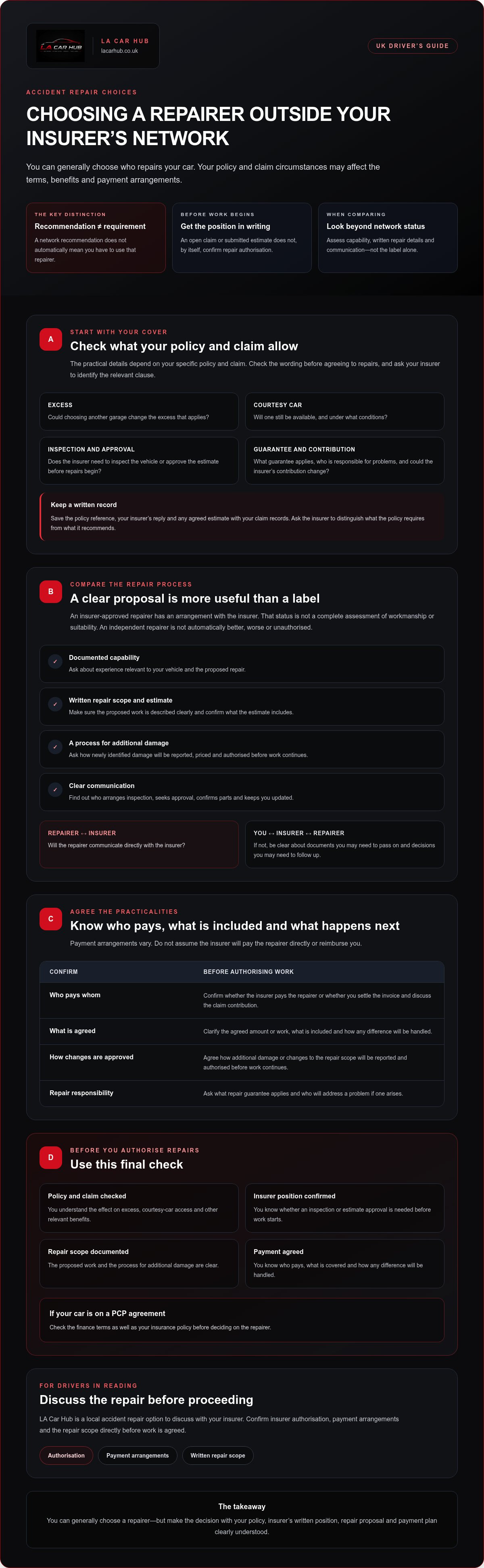
What to do before authorising a non-approved repair
Take the process one step at a time. If the vehicle may be unsafe to drive, do not use it until you have established what is safe. Contact your insurer and follow its instructions for reporting the accident. Choosing a repairer is separate from getting the claim and repair work authorised.
A practical sequence from claim notification to repair approval
- Notify your insurer. Explain that you’re considering a repairer outside its network. Ask how your policy handles this choice, whether the vehicle needs an inspection and what documents it requires.
- Arrange an assessment. Ask the insurer and repairer who will inspect the vehicle and prepare the estimate. Share the estimate and any relevant photographs or assessment documents with your insurer.
- Compare any differences. If the insurer’s and repairer’s estimates do not match, ask both to explain which work or parts differ and why. Request an itemised response and clarification of what the insurer will authorise or contribute. A difference does not guarantee that either estimate will be accepted in full.
- Get the terms in writing. Before work starts, confirm the agreed repair scope, payment arrangements and any conditions. Make sure you know who has authorised the work and whether approval covers the full estimate or only specified repairs.
Do not assume an inspection has happened, an estimate has been accepted or repairs have been approved just because the insurer has opened a claim or received paperwork. If further damage is found after work begins, pause and ask how it will be documented, priced and approved before the scope changes.
If there is disagreement or a delay
Ask the insurer to set out its decision and the policy wording it relies on. Keep dated copies of estimates, messages, decisions, unanswered questions and any complaint reference. If you’re unhappy with the insurer’s handling, use its formal complaints process first and keep the final response.
If the issue remains unresolved, check the Financial Ombudsman Service’s current guidance, eligibility criteria and referral steps. Not every disagreement will qualify, so confirm that your complaint and circumstances fall within its remit before applying.
If you’re considering accident repair not using insurance approved repairer uk, LA Car Hub is a Reading option for discussing repair scope and payment arrangements. Discuss your accident repair requirements, then confirm insurer authorisation and agreed terms before proceeding.
Choosing accident repair in Reading and agreeing your next steps
For Reading drivers, a repairer’s network status is only one part of the decision. Compare the inspection details, proposed repair scope, communication and written terms. Ask how the repairer handles insurer estimates, authorisation and additional damage uncovered during the work. Then check directly with your insurer that the repairer’s process fits the requirements of your claim before committing.
How to compare Reading repair options fairly
Look for a clear explanation of what has been inspected and which repairs or replacement parts are included in the estimate. Ask who will keep you informed, how changes to the agreed scope will be discussed, and whether the repairer will communicate with your insurer or need you to pass on information. If a repairer mentions a membership, standard or warranty, ask what it covers and verify the details with the organisation or provider concerned.
These questions help you compare the actual arrangements rather than relying on a label such as “approved” or “independent”. A written estimate is a proposal, not necessarily insurer approval. Confirm what the insurer has authorised and what payment arrangement applies before repairs begin.
What to have ready when you make an enquiry
A few details can make an initial conversation more useful. Have the vehicle’s make, model and registration to hand, along with a brief account of the incident, photographs of visible damage and your insurer’s claim reference if available. Explain whether the insurer has inspected the vehicle, received an estimate or issued repair instructions. This helps the repairer understand what has happened so far, but it does not confirm that the insurer will accept the repair or pay the invoice.
Use this short checklist when speaking with both parties:
- What damage has been inspected, and what work does the estimate cover?
- Who will arrange inspection and seek insurer approval?
- How will additional damage or changes to the scope be agreed?
- Who pays the repairer, and what has the insurer confirmed in writing?
- What updates and repair terms will I receive in writing?
LA Car Hub is a Reading accident-repair option with a body shop handling accident repairs, structural repair, panel replacement and spray painting. If you’re considering accident repair not using insurance approved repairer uk, discuss your repair needs and arrangements with LA Car Hub about accident repairs. Confirm insurer authorisation, payment arrangements and the agreed repair scope directly before proceeding.
Make your repair choice with confidence
You may be able to choose a repairer outside your insurer’s network, but check your policy and claim arrangements before authorising work. Confirm any effect on your excess, courtesy-car access and repair guarantee, and get the agreed repair scope and payment terms in writing. A clear estimate, documented capability and good communication are more useful measures than network status alone.
If you’re considering accident repair not using insurance approved repairer uk, confirm who will inspect the vehicle, approve the work and handle changes to the estimate. These steps can help you make a considered choice and avoid misunderstandings as the repair progresses.
LA Car Hub is a Reading body shop offering accident repairs and spray painting. Invoices may be settled directly by vehicle owners or billed through major UK motor insurers. Confirm the current payment arrangements and any insurer authorisation needed for your claim. Discuss your accident repair with LA Car Hub and clarify the process before proceeding.
Frequently Asked Questions
Can I choose my own accident repairer in the UK?
Generally, yes, you can ask to use a repairer of your choice, but your policy and the circumstances of your claim affect the arrangements. Before booking repairs, tell your insurer which garage you’re considering and ask whether it needs to inspect the car or agree the estimate first. Check the excess, courtesy-car terms and payment process too, so you understand any differences before authorising work.
Can my insurer force me to use an approved repairer?
An insurer can recommend its approved network, but it should explain the policy terms that apply if you choose another repairer rather than treating its recommendation as compulsory. Ask it to identify the relevant clause in writing. The clause may set conditions around benefits or payment. If you’re unsure what the wording means for your claim, ask the insurer to clarify before making arrangements.
Will using a non-approved repairer affect my insurance claim?
It may affect parts of the claim, depending on your policy and circumstances. For example, the excess, courtesy-car access, repair guarantee or insurer contribution may differ outside the network. The insurer may also need to inspect the vehicle or agree the estimate before work starts. Confirm what it will authorise and how payment will work in writing. Do not assume that an open claim means repairs are approved.
Can I claim back the cost of repairs from my insurer?
Possibly, but do not assume you’ll be reimbursed in full, or that paying the invoice yourself is the required process. Your insurer may need to approve the repair scope and estimate beforehand, and the policy may limit what it contributes. Ask who pays the repairer, what amount or work is authorised, and whether you’re responsible for any difference. Get the payment arrangement confirmed in writing before work begins.
What should I check before using an independent accident repairer?
Ask for a written estimate that explains the damage identified, work proposed and any parts included. Find out who will inspect the vehicle, how hidden damage or extra work will be handled, and whether the repairer coordinates with your insurer. Check claimed memberships, repair standards and workmanship terms directly. If you’re researching “accident repair not using insurance approved repairer uk”, remember to confirm insurer authorisation and payment arrangements before proceeding.
Can I change repairer after my insurer has arranged repairs?
You can ask to change repairer, but first check what has already been agreed or started. Contact your insurer and ask whether an inspection, parts order or repair authorisation is in place, and whether changing garages affects your claim, excess, courtesy car or payment arrangements. Get any revised instructions in writing. If the vehicle is already at a repairer, clarify collection or transfer arrangements before making a change.
What can I do if my insurer and repairer disagree about the repair?
Ask both parties to explain the difference in writing. Compare the estimates line by line and ask what work or parts are disputed, then clarify what the insurer will authorise and what you may need to pay. Keep dated records of estimates and decisions. If the issue concerns your insurer, use its formal complaints process first. You can then check the Financial Ombudsman Service’s current guidance and eligibility, as not every dispute qualifies.


