
The visible dent may be the least of your worries. Damage that looks cosmetic can conceal problems beneath the surface, so choosing a repairer should start with finding out what your vehicle needs. If you’re searching for “accident repair centre reading”, look beyond convenience and ask how the damage will be assessed.
It’s natural to feel unsure after a collision. You may be concerned about repair quality, how long the work could take and whether to claim through your insurer or choose a repairer yourself. A clear explanation of the proposed work and costs can help you make an informed decision.
This guide explains what to look for in a Reading accident repair centre, what to expect from assessment through to repair, and which questions to ask before authorising work. It also covers points to discuss with your insurer and how to check whether a repairer’s services suit the damage. LA Car Hub is a Reading based option for discussing collision damage, with crash repairs and spray painting available through its body shop.
Key Takeaways
- Choose an accident repair centre in Reading by checking that its repair capabilities match the damage and that it clearly explains the proposed work.
- Understand how structural repairs, panel work and paint refinishing differ, so you can ask which types of repair your vehicle may need.
- Expect the process to involve an enquiry, an assessment, authorisation, repairs and handover. Timing and repair scope can depend on inspection findings and parts availability.
- Before authorising work, ask who will assess the damage, how the repair plan will be explained and what to check with your insurer.
- LA Car Hub’s Reading body shop offers crash repairs and spray painting. Ask the team whether its services suit your vehicle’s needs.
Accident repair in Reading: what should happen after vehicle damage?
Collision damage can be unsettling, particularly when you’re unsure whether the car is safe to use or what needs repairing. An accident repair centre assesses and repairs damage caused by a collision. If you’re searching for “accident repair centre reading”, look for a repairer who can explain how an inspection will establish what your vehicle needs.
A dented panel or scraped paint may be easy to spot, but damage behind the bodywork may not be visible. The impact, the area affected and the vehicle itself all influence what needs checking. General information about types of repair shops can help explain how body shops differ from other automotive businesses, but it can’t determine the condition of your car.
Accident repair addresses collision related damage; routine servicing focuses on scheduled maintenance and general vehicle upkeep. A repair centre needs to inspect the vehicle before confirming the work required. Photos can help you describe the incident, but they can’t replace an inspection or provide a remote diagnosis.
What can an accident repair centre assess?
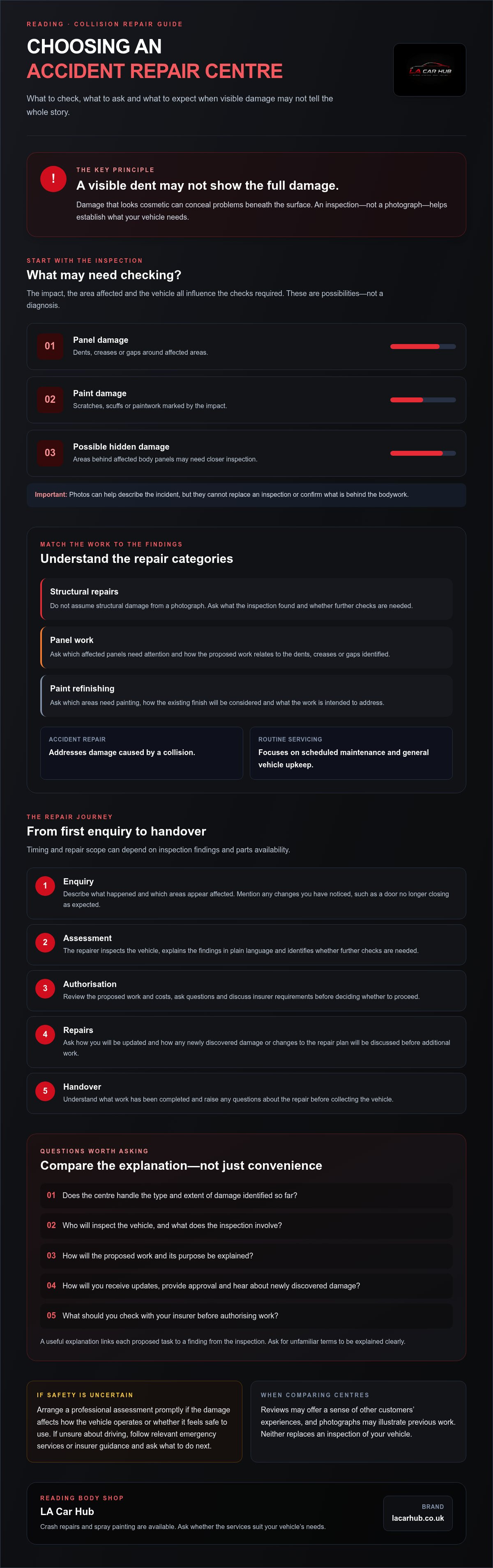
An inspection may consider visible panel damage and paintwork, as well as possible damage behind affected body panels. The checks needed depend on the impact and the part of the vehicle involved. The repairer should explain what they’ve found and whether any further checks are needed before setting out the proposed work.
- Panel damage: dents, creases or gaps around affected areas.
- Paint damage: scratches, scuffs or paintwork marked by the impact.
- Possible hidden damage: areas behind panels that may need closer inspection.
These are possibilities, not a diagnosis. A mark that looks minor doesn’t confirm that the damage is only on the surface.
When should you seek a professional inspection?
Arrange an assessment promptly if the damage affects how the vehicle operates or whether it feels safe to use. Don’t rely on photographs to decide whether there’s structural damage. They can show visible marks, but they can’t establish what is happening behind the bodywork. If you’re unsure about driving the car, follow relevant emergency services or insurer guidance and ask what to do next.
At the inspection, describe what happened and mention any changes you’ve noticed, such as a door that no longer closes as expected. This gives the repairer useful context without assuming the cause. Ask them to explain their findings in plain language before you consider authorising work.
How to compare accident repair centres in Reading
Compare what each centre can assess and repair, rather than relying on claims about equipment alone. A well equipped body shop may suit some jobs, but that doesn’t confirm it can carry out every repair your vehicle needs. The inspection and the repairer’s explanation will help you judge whether its capabilities match the damage.
Before contacting a centre, note which areas are affected and describe how the damage happened. If you’re dealing with the immediate aftermath, GOV.UK explains what to do after an accident. Then ask who will assess the vehicle, what the inspection involves and how the proposed work will be explained before you decide whether to proceed.
Questions to ask before choosing a repairer
Use the first conversation to find out whether the centre is a practical fit. You don’t need to know the technical cause of the damage. Give an honest description and ask what needs checking before the repairer can confirm a plan.
- Does the centre handle the type and extent of damage identified so far?
- Who will inspect the vehicle, and what does the inspection involve?
- How will the proposed work and its purpose be explained?
- How will you receive updates, provide approval and hear about any newly discovered damage?
Ask how changes to the repair plan will be discussed before additional work is carried out. Clear communication helps you understand what has changed and decide what to do.
How to assess repair explanations and evidence
A useful explanation links each proposed task to a finding from the inspection. If paint refinishing is proposed, ask which areas need painting, how the existing finish will be considered and what the work is intended to address. You should be able to ask questions without being expected to accept unfamiliar terms at face value.
Online reviews may give you a sense of other customers’ experiences, while photographs can illustrate previous work. Neither establishes what your vehicle needs. Treat them as background, not proof that a centre is suitable for your repair.
Quick checklist: confirm the repairer handles your type of damage, ask who will inspect the car, request a clear explanation of the proposed work, and agree how updates or newly found damage will be discussed.
If you’re comparing local options for accident repairs in Reading, LA Car Hub is a Reading based automotive centre with a fully equipped body shop offering crash repairs and spray painting. You can discuss your vehicle’s accident damage and ask whether the centre is suitable for the repair you need.
Structural damage, panel repairs and paintwork: matching the repair to the damage
Collision damage can call for different kinds of work. Not every vehicle needs structural repairs, panel work and paint refinishing together. A dent or scrape gives only an initial impression. An inspection should establish what is affected and which work is appropriate.
This distinction matters when comparing accident repair centres in Reading. Ask the repairer to explain what the assessment found and how each proposed task relates to the damage. The categories below are a guide, not a diagnosis.
| Repair category | What it generally addresses | What to clarify |
|---|---|---|
| Structural repair | Damage to affected parts of the vehicle’s structure. | What inspection identified the affected area, and what work is proposed? |
| Panel repair | Damage to an exterior body panel, where repair is appropriate. | Can the panel be repaired, or does the assessment indicate another approach? |
| Paint refinishing | Paintwork needed as part of work on a repaired or replaced area. | Which area needs refinishing, and how will the vehicle’s finish be considered? |
How structural repair differs from panel repair
Structural work concerns affected parts of the vehicle’s structure and needs an assessment suited to the damage. Panel repair concerns exterior bodywork, such as a dented door or wing, where the inspection indicates repair is appropriate. Appearance alone can’t confirm whether damage is limited to a panel or extends behind it. Ask the repairer to explain the inspection findings before agreeing to the scope of work.
When accident repairs also involve spray painting
Refinishing may be part of restoring a repaired or replaced panel, but it isn’t automatically needed for every collision repair. The paintwork required depends on the inspection, the work carried out and the vehicle’s finish. Ask which areas would be painted and why. Don’t assume a repairer offers computerised paint matching unless they confirm that capability.
For general questions to consider around estimates and repair work, the US Federal Trade Commission’s guide to choosing a reputable auto repair shop may be useful. It’s US guidance, not UK specific advice, so use it as a general prompt rather than a source for UK rules.
Keep the same principle in mind as you compare repairers: the assessment should guide the work, not a first impression or a photograph. Related guides on structural repairs and panel repairs can provide more detail on those specific types of work.
Reading repair centre: from assessment to collection
Knowing the usual steps can make an accident repair feel more manageable. The process varies with the damage and the repairer, but generally moves from an initial enquiry to an assessment, a repair plan, your authorisation, the repair itself and handover. When considering an accident repair centre in Reading, ask how each stage will be explained and who to contact with questions.
What to prepare for an initial repair enquiry
Give the centre a clear starting point. Gather the vehicle’s make, model and registration, a brief description of what happened, and photographs showing the affected areas from more than one angle. Images can help explain the damage, but the repairer may still need to inspect the vehicle in person before confirming the work.
If you’re making an insurance claim, keep relevant claim details and messages together. Share information with the repair centre where appropriate, and check your policy or speak to your insurer about its process. Don’t assume the repairer can confirm what your policy covers.
What to clarify before repair work begins
After inspection, ask for a clear repair plan before deciding whether to authorise work. It should explain what repairs are proposed, why they’re needed and any exclusions or limits. If further damage is found once work begins, ask how the centre will contact you, explain the change and seek your approval before proceeding.
Timing and the final scope can depend on what the inspection reveals and whether the necessary parts are available. Ask what stages to expect and how you’ll receive updates. Confirm collection arrangements directly with the repairer rather than relying on assumptions.
- Enquiry: Describe the incident and share vehicle details and photographs.
- Assessment: Arrange any inspection the repairer says is needed.
- Repair plan: Review the proposed work, exclusions and expected steps.
- Authorisation: Confirm what you’re agreeing to before work begins.
- Repair and handover: Ask about progress, then clarify collection arrangements and what will be explained at handover.
Keep a simple record of the damage, your questions and the repairer’s responses. Store insurer correspondence with your claim information, and refer to your policy or insurer for guidance on the claim and repair arrangements. This helps keep decisions and communications clear.
To discuss collision damage and ask whether your vehicle may be suitable for assessment, enquire about accident repairs with LA Car Hub, a Reading based centre offering crash repairs and spray painting.
Choosing LA Car Hub for accident repair in Reading
LA Car Hub is a Reading based automotive centre with a fully equipped body shop. Its body shop offers crash repairs and spray painting, giving local drivers a place to discuss collision damage and whether the centre may suit the work required. If you’re comparing accident repair centres in Reading, describe the damage and ask what the team can assess.
A body shop’s equipment or service list doesn’t, on its own, confirm that it can carry out every repair. Suitability depends on the vehicle and the damage found during assessment. If you think structural work may be needed, ask the business directly rather than assuming it’s included in its crash repair service.
What LA Car Hub can help you discuss
You can ask about crash repairs and spray painting, and explain which parts of the vehicle were affected. For example, mention whether you can see a dent, scraped paint or damage around a particular panel. These details help start the conversation, but they don’t establish the full repair scope. Ask whether an assessment is needed and what the centre can confirm after inspecting the vehicle.
If the damage appears structural, describe what you’ve noticed and ask whether LA Car Hub can assess that type of work. Don’t treat a photograph or an initial conversation as confirmation that structural repairs are available or required. The team should clarify what it can help with once it understands the vehicle and the damage.
How to take the next step
Contact the Reading team with the vehicle’s make and model, a concise account of the incident and a clear description of the visible damage. Ask what information they need, whether the vehicle must be inspected in person and how to arrange an assessment. If you have photographs or relevant insurer information, ask whether these would be useful at the enquiry stage.
LA Car Hub also offers detailing and alloy refurbishment among its wider automotive services. These are separate offerings, so keep your enquiry focused on the collision damage and ask directly if you have a related need. Confirm the repair scope, practical arrangements and next steps with the team before making a decision.
If you’d like to discuss your vehicle’s damage and check whether the centre may be suitable, talk to LA Car Hub about accident repairs. Share what you know and ask what an assessment would involve.
Take the next step with confidence
Choosing a repairer starts with an assessment, not a guess based on a dent or photograph. Ask what damage has been identified, which repairs are proposed and how you’ll be kept informed if the work needs to change. The final repair scope and timing can depend on inspection findings and parts availability, so clear answers matter. Keep insurer communications together and check your policy or speak to your insurer about its repair process.
If you’re searching for an accident repair centre in Reading, LA Car Hub is a local automotive centre with a fully equipped body shop offering crash repairs and spray painting. Describe the damage and ask whether the centre may suit your vehicle and what an assessment involves.
You don’t need to have every answer before making an enquiry. Sharing the vehicle details and a straightforward account of what happened is a practical first step. Talk to LA Car Hub about accident repairs and find out what information the team needs.
Frequently Asked Questions
Can I choose my own accident repair centre in the UK?
You can ask to use a repairer of your choice, but how this works with an insurance claim depends on your policy and your insurer’s process. Check with your insurer before authorising repairs and ask whether there are requirements you need to follow. If you’re looking at accident repair centres in Reading, compare repair capability and communication as well as location. Confirm directly with both the repairer and insurer how the claim will be handled.
How do I know if my car has structural damage after an accident?
You can’t confirm structural damage from the vehicle’s appearance or photographs alone. A dented panel may look minor, but images can’t show what lies behind the bodywork. Arrange a professional inspection and describe how the impact happened and which areas were affected. Ask the repairer to explain what they assessed and whether further checks are needed. If you’re unsure whether the car is safe to use, seek appropriate guidance rather than guessing.
What happens when an accident repair centre assesses my car?
The repairer inspects the affected areas to understand the visible damage and identify whether further inspection may be needed. They’ll use their findings to explain the proposed work and its purpose. The repair scope shouldn’t be confirmed from photographs alone. Ask who is carrying out the assessment, what it covers and how any newly discovered damage will be discussed. The process and checks required depend on the impact, affected areas and vehicle.
Can an accident repair centre match my car's paint colour?
A repair centre may be able to assess and match paint for refinishing, but the method and result depend on the vehicle’s finish and the work required. Ask how the colour will be identified and whether the proposed paintwork covers a repaired or replaced panel. LA Car Hub offers spray painting. Confirm directly with the team what paintwork is suitable for your vehicle, and don’t assume a particular matching method or finish without checking.
How long do accident repairs take?
There isn’t one timeframe for every repair. The duration depends on what the inspection finds, the work agreed and whether the necessary parts are available. Ask the repairer what stages to expect and when they expect to update you. If the scope changes or parts availability affects progress, ask how you’ll be informed. Confirm expected timing directly with the repair centre before making arrangements around collection.
Should I contact my insurer before arranging accident repairs?
Check your policy and contact your insurer before authorising repair work, particularly if you intend to make a claim. Ask about the steps they require, any conditions that apply and how they handle your chosen repairer. Processes can differ, so don’t assume a repair centre can confirm what your policy covers. Keep claim details and insurer messages together, and share relevant information with the repairer where appropriate.
What information should I give a repair centre when enquiring?
Give the repairer the vehicle’s make, model and registration, a short description of what happened and which areas appear damaged. Clear photographs can help explain what you can see, but they don’t replace an inspection. If relevant, have your insurer or claim details ready and ask whether the repairer needs them. Also check whether the vehicle must be inspected in person before the centre can discuss the likely repair scope.

