
Could a car look almost unmarked after a collision yet still have damage beneath the panels? It’s a fair concern when you’re considering structural car repair in Reading and aren’t sure what an initial inspection can reveal. Visible dents don’t always show the full extent of damage, so it helps to understand how a repairer assesses the vehicle before recommending work.
Structural repair addresses parts of a vehicle’s frame or body that contribute to its strength and alignment. The right approach depends on the damage and the vehicle, which is why clear explanations matter. Ask what’s been found, what work is proposed and what checks are planned, so you can make an informed decision.
This guide explains structural damage in plain English, outlines the assessment and repair stages you may encounter, and suggests useful questions to ask before authorising work. LA Car Hub in Reading lists collision and structural repairs, including panel replacement and bodywork restoration. You can begin with a conversation about the damage and the appropriate next step.
Key Takeaways
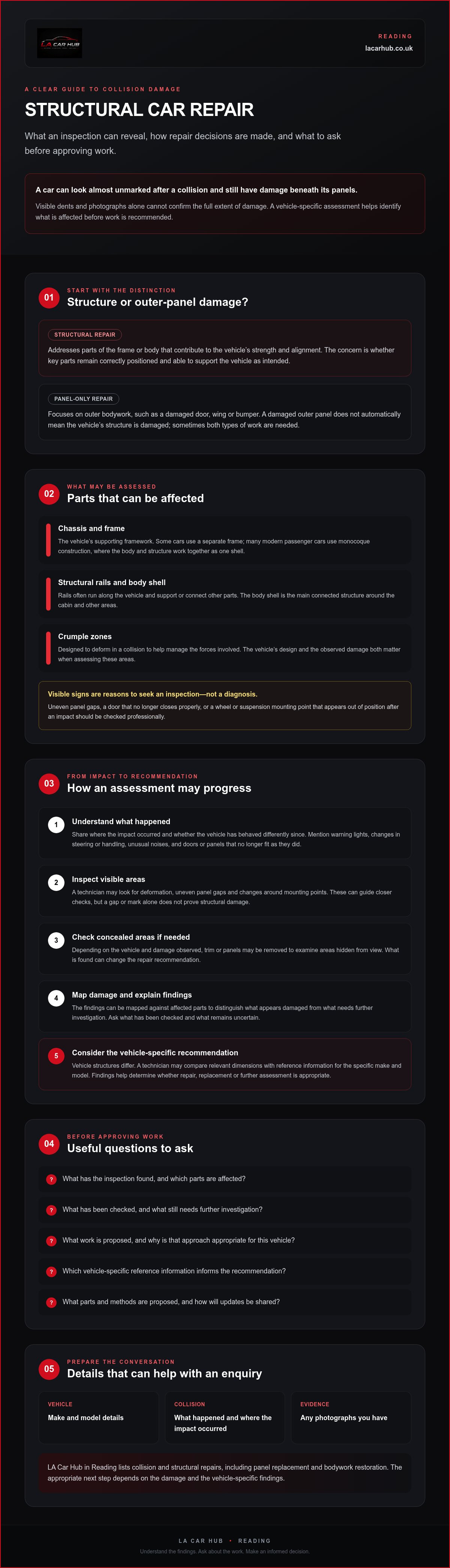
- Learn why damage to load-bearing or alignment-critical parts differs from cosmetic damage, and why appearance alone can’t confirm what’s needed.
- Understand how a repairer may map damage, including by inspecting areas hidden behind panels or trim.
- See how vehicle-specific findings help determine whether repair, replacement or further assessment is appropriate.
- Use practical questions about findings, methods, parts and updates to make an informed decision about structural car repair in Reading.
- Prepare a useful enquiry for LA Car Hub with your vehicle details, collision information and any photographs you have.
What structural car repair means after a collision in Reading
Structural car repair restores or replaces parts of a vehicle’s load-bearing or alignment-critical structure after damage. It differs from repairing a scratch or replacing a dented outer panel. The concern is whether key parts remain correctly positioned and able to support the vehicle as intended.
A collision can transfer force beyond the point of impact. A bumper or wing may show obvious damage, while brackets or structural sections behind it may also need checking. Photographs and appearance alone can’t reliably establish the extent of damage. An assessment helps identify what is affected before a repair is recommended.
Which parts of a car can suffer structural damage?
The chassis is the vehicle’s supporting framework. Some cars use a separate frame, while many modern passenger cars use monocoque construction, where the body and structure work together as one shell. Designs differ; the vehicle frame entry gives a useful overview of these approaches.
Structural rails are sections of the framework that often run along the vehicle and support or connect other parts. The body shell includes the main connected structure around the cabin and other areas. Crumple zones are designed to deform in a collision to help manage the forces involved. Damage in these areas needs a vehicle-specific assessment, not assumptions based on what can be seen outside.
How structural damage differs from panel damage
A damaged door, wing or bumper doesn’t automatically mean the car’s structure is damaged. The problem may be limited to an outer panel or its fixings. However, uneven panel gaps, a door that no longer closes properly, or a wheel or suspension mounting point that appears out of position after an impact are reasons to seek a professional inspection, not to diagnose the fault yourself.
Panel-only repairs focus on outer bodywork, while structural work addresses parts that support the vehicle or affect alignment. Sometimes both are needed. A repairer may need to inspect behind a panel to understand how far the damage extends. For a closer look at dents and creases in outer bodywork, see the planned panel repair guide.
If you’re searching for structural car repair reading, keep the distinction in mind: visible damage can guide an initial conversation, but it can’t confirm what lies beneath. Ask what the inspection found and which parts are affected. That gives you a clearer basis for understanding the recommended work before deciding how to proceed.
How a Reading repairer assesses structural car damage
A thorough assessment moves from understanding what happened to identifying what the vehicle needs. The repairer’s initial questions help establish the circumstances of the impact. An inspection then looks for damage, followed by damage mapping and a recommendation. The depth of inspection depends on the vehicle and what the first checks reveal. Visible damage alone can’t confirm a vehicle’s structural condition, because collision forces may affect areas hidden from view.
What happens during an initial structural inspection?
Share what you know about the collision, including where the impact occurred and whether the vehicle has behaved differently since. Mention warning lights, changes in steering or handling, unusual noises, and doors or panels that no longer fit as they did. These details can help guide the inspection, but they aren’t diagnoses in themselves.
A technician may look for deformation, uneven panel gaps and changes around mounting points. These signs can indicate where closer checks are needed, but a gap or mark doesn’t prove structural damage. Depending on the vehicle and the damage observed, the inspection may involve removing trim or panels to examine concealed areas. This can reveal damage that wasn’t visible at first and may change the repair recommendation.
The findings can then be mapped against the affected parts, helping distinguish what appears damaged from what needs further investigation. Ask what has been checked, what remains uncertain and how the findings support the recommendation. For a driver considering structural car repair reading, this staged explanation makes it easier to understand the assessment before agreeing to work.
Why measurement and vehicle-specific repair information matter
Vehicle structures differ, so a technician may compare relevant dimensions with reference information for the specific make and model. This can help identify whether structural points have shifted. Repair methods should reflect the vehicle’s design, the location and extent of damage, and the professional findings. Ask which reference information informs the recommendation and whether any areas still need closer inspection.
Modern vehicles may also have cameras or sensors linked to driver-assistance features. The Insurance Institute for Highway Safety explains how these systems can complicate repairs, including where calibration may be relevant. If the collision or proposed work affects these components, ask whether checks or calibration are needed, who will carry them out and whether they’re included in the repair plan. Ask the repairer to confirm what applies to your vehicle.
LA Car Hub lists structural and collision repairs in Reading. To discuss an assessment, you can contact LA Car Hub about collision repairs and share your vehicle details and what happened. Start with the information available rather than assumptions about the damage.
Repair or replacement? Weighing structural car repair options
Structural damage doesn’t automatically mean a vehicle is unsafe to repair or beyond repair. The right option depends on what the inspection finds, where the damage is, how the vehicle is built and what repair information applies to that model. A recommendation should be based on those findings, not a general rule about the type of collision.
The next step may be to repair a damaged section, replace a component, or carry out further assessment before deciding. Each option should have a clear reason. A repair recommendation describes work the repairer considers suitable based on their findings. It isn’t the same as an insurer’s decision about a claim or settlement, which should be discussed directly with the insurer.
When might structural repair be considered?
A repairer considers the affected area alongside the vehicle’s construction and applicable vehicle-specific procedures. Some damage may be suitable for repair; in other cases, replacing a section or component may be recommended. If the extent of damage isn’t clear, further inspection may be needed before either option can be assessed properly.
Ask what evidence supports the recommendation. Which parts are affected? What information was used to reach the conclusion? What remains uncertain? Clear answers help you understand why a repair or replacement is being considered, without assuming one outcome is right for every vehicle.
When should a driver pause before authorising work?
Pause and ask for clarification if the proposed method, the parts to be repaired or replaced, or the checks after the work aren’t clear. You can request the findings and recommendations in writing, and ask how newly discovered damage will be discussed before the scope changes. This gives you a clearer record of what you’re being asked to approve.
If an insurance claim is involved, speak with your insurer about its assessment, settlement decision and any approval process before authorising work. Keep the repairer’s technical recommendation separate from the insurer’s financial decision; one doesn’t automatically settle the other.
For context, the US National Highway Traffic Safety Administration’s letter discusses the limits of its role concerning replacement parts and refers to “knowingly making inoperative”. It isn’t UK guidance, so don’t treat it as a standard for repairs in Reading. The practical takeaway is to ask which parts and methods are proposed, how they relate to your vehicle, and what safety-related checks are included.
For structural car repair reading, a considered decision starts with vehicle-specific findings. If anything in the recommendation is unclear, ask for an explanation before agreeing to the work.
Questions to ask before approving structural car repair in Reading
A clear repair plan should explain what’s known, what work is proposed and how you’ll be kept informed. You don’t need to know technical terms to ask for a straightforward explanation. If something isn’t clear, ask before agreeing to the work.
How to judge a repair plan and communication
Use these questions when speaking with a Reading repair centre:
- What damage did the inspection find? Ask which areas were checked and whether any damage is still uncertain or concealed.
- What work do you recommend, and why? Ask what will be repaired or replaced, and how the proposed method relates to your vehicle’s findings.
- Which replacement parts are proposed? Ask how the repairer will identify the parts and confirm they’re suitable for your vehicle.
- What checks will be made after the repair? Ask which checks apply to your vehicle and what the repairer can confirm about its process.
- How will you keep me updated? Agree how updates will be shared and what will happen if further damage is found or the work needs to change.
Ask for the inspection findings, agreed work and any later changes to be documented. A written record makes it easier to follow what was completed, understand any remaining recommendations, and discuss questions with the repairer or insurer. Confirm what documents and checks are included rather than assuming.
What to clarify about insurance and vehicle use
If you’re making a claim, contact your insurer directly before committing. Confirm its repair authorisation process, any excess that applies and whether it has requirements about estimates, updates or documentation. Don’t assume a repairer is approved by your insurer. Check with the insurer and ask the repairer what arrangements apply to your case.
Ask whether the collision or planned work means any post-repair checks or sensor calibrations apply to your specific vehicle, and who will carry them out. If you’re unsure whether the car is safe to drive, don’t use it until you’ve sought appropriate professional advice. Ask your insurer or another suitable provider about arranging recovery if needed.
Keep this checklist handy if you’ve searched for structural car repair reading. For a local conversation about collision and structural repairs, contact LA Car Hub to discuss your vehicle. Share what happened and ask what assessment is appropriate before deciding on work.
Discuss structural car repairs with LA Car Hub in Reading
LA Car Hub is a Reading-based automotive centre that lists collision repairs, including structural repair, panel replacement and bodywork restoration. If your vehicle has been involved in an impact, an initial conversation can help establish what information is available and what the next step might be. It can’t confirm the full repair scope; that depends on an assessment of the vehicle.
What information to prepare for an enquiry
A few details can make the first conversation more useful. Have these to hand if available:
- Vehicle details: make, model and registration details.
- Collision account: where and how the impact happened, and which parts appear affected.
- Changes since the collision: warning lights, unusual noises, or changes to steering, handling or how doors close. These are observations, not a diagnosis.
- Photographs: images of visible damage can help explain the situation, but can’t show what may be concealed behind panels.
- Insurance information: claim details or insurer instructions, if you’re considering a claim.
You don’t need to have every detail. Share what you know and be clear about anything you’re unsure of. That gives the repairer useful context without presenting an assumption as a confirmed finding.
What to expect from a first conversation
Information shared by phone or online can guide the discussion, but it can’t replace an inspection. Damage may extend beyond what’s visible, or the assessment may show that the issue is limited to outer bodywork. Until the vehicle has been assessed, a repairer can’t confirm the appropriate work, whether it’s feasible, or the timing and cost.
Use the conversation to ask what an assessment involves, how findings and recommendations will be explained, and how you’ll receive updates if the scope changes. If an insurer is involved, check its process directly and share any relevant instructions with the repairer. This helps keep the assessment, repair recommendation and claim process clear without assuming they’re all decided at the same stage.
If you’re looking into structural car repair reading, LA Car Hub can be a local starting point for discussing collision damage. Bring your vehicle details and a brief account of what happened, then agree an appropriate next step based on the information available. Talk to LA Car Hub about structural repair.
Take a clear next step after a collision
Structural damage can’t be confirmed by appearance alone. A careful assessment helps identify which parts are affected and whether repair, replacement or further inspection is recommended. Before authorising work, ask for the findings, proposed method and relevant checks to be explained clearly. If insurance is involved, confirm the claim and authorisation process directly with your insurer.
If you’re considering structural car repair reading, LA Car Hub is a Reading-based automotive centre listing structural and collision repairs. Its body shop handles collision repairs, including panel replacement and bodywork restoration. An assessment is needed before the repair scope or outcome can be confirmed, so start with the details you have and ask what should happen next.
Discuss your vehicle with LA Car Hub and share what happened, your vehicle details and any photographs available. Ask the team about the next step for your vehicle.
Frequently Asked Questions
What is structural car repair?
Structural car repair addresses damage to load-bearing or alignment-critical areas after a collision. It differs from cosmetic panel repair, which focuses on outer bodywork such as a scratched or dented door. Vehicle designs vary, so the affected structure and suitable repair method depend on the specific car and damage. In Reading, as elsewhere, an inspection is needed to identify what’s affected and support a repair recommendation.
Can a car be driven with structural damage?
Whether a car can be driven depends on the location and extent of the damage, which can’t be judged reliably from appearance alone. A vehicle may look mostly intact but still need assessment. If you notice changes in handling, warning lights or damage that seems significant, stop driving and seek professional advice. Don’t assume the car is safe or unsafe without an appropriate assessment.
How do I know if my car has structural damage after an accident?
Deformation, uneven panel gaps or changes in handling can be warning signs, but none proves structural damage on its own. Some damage may be hidden behind panels or trim, so the outside appearance won’t always tell the whole story. After a significant impact, arrange a professional inspection. A technician may need to examine concealed areas or compare structural dimensions with information specific to your vehicle.
Can structural damage to a car be repaired?
Some structural damage may be repairable, but the appropriate outcome depends on the vehicle, the location and extent of damage, and professional findings. A repairer may recommend repairing a section, replacing a component or carrying out further assessment. Any proposed work should suit the vehicle and follow relevant vehicle-specific procedures. Ask what evidence supports the recommendation and what remains uncertain; no outcome can be guaranteed before assessment.
How long does structural car repair take?
There’s no reliable universal timeframe for structural car repair. Duration can depend on the extent of damage, inspection findings, parts availability, repair complexity and any additional work identified during the process. Ask the repairer for an estimate once the vehicle has been assessed, and check how updates will be provided. If new findings change the repair scope, ask how that may affect the expected completion date.
Will my insurer let me choose a structural repairer in Reading?
Your options depend on your policy and the insurer’s claim process, so check directly with them before authorising repairs. Ask whether you need to use an approved repairer, what authorisation is required, how your excess applies and how any settlement will be handled. Don’t assume a Reading repairer is approved or that a repair recommendation settles the insurance claim; confirm each point with your insurer.
What should I ask a structural car repairer before approving the work?
Ask what damage the inspection found, why the proposed method suits your vehicle, and which parts or procedures are involved. Clarify what checks will follow the repair and how you’ll receive updates, especially if further damage is found. Request a clear written explanation of the agreed work and any remaining recommendations. If you’re claiming through insurance, confirm the repair plan and authorisation process with your insurer too.

