
A computer can help find a close paint formula, but it can’t guarantee that a repaired panel will look identical. If you’re searching for “computerised paint matching reading”, you’re likely trying to avoid a visible difference between old and new paint. It’s a reasonable concern: paint can fade over time, and the final appearance also depends on how it is applied and blended.
This guide explains how computerised matching can help a repairer identify a suitable formula, and why it is only one part of the process. You’ll learn how paint condition, lighting and spray technique can affect the result, as well as what the technology can’t account for on its own.
We’ll also cover the main refinishing steps and practical questions to ask before approving paintwork in Reading. That way, you can understand what your repairer plans to do, how they’ll assess the match and where careful preparation and blending can make a difference.
Key Takeaways
- Computerised tools can help a repairer find or refine a paint formula, but professional assessment and refinishing still shape the result.
- For computerised paint matching in Reading, the equipment and process can vary between repairers, so ask how they’ll assess your car’s colour.
- Ageing, fading, previous paintwork and surface condition can all affect how closely new paint appears to match.
- Before approving work, ask whether it will be localised, cover the whole panel or involve wider refinishing, and how the finish will be checked.
- LA Car Hub’s Reading body shop offers spray painting and crash repairs. Discuss your paintwork needs and the proposed approach before proceeding.
What Is Computerised Paint Matching for Car Repairs in Reading?
Computerised paint matching uses digital tools to help a repairer identify or refine a formula close to the colour on your car. The equipment supports a skilled assessment. It doesn’t inspect every factor, prepare the panel or complete the repair by itself.
Computerised paint matching helps identify a suitable paint formula. The finished visual match depends on how that formula is assessed, prepared and applied to the vehicle.
A manufacturer’s paint code gives the repairer a useful starting point. However, it describes the factory specification, not necessarily the colour your car shows today. Sunlight, weathering, surface condition and previous refinishing can all affect its appearance. As Modern automobile paint explains, automotive finishes involve several layers and application stages. Choosing the right colour is only part of achieving a consistent result.
What information does a car’s paint code provide?
Manufacturers use paint codes to identify a factory paint specification, helping a repairer find an appropriate formula to begin with. Depending on the vehicle, the code may be on a label in a door opening, under the bonnet or elsewhere. Locations vary, so check your handbook or vehicle-specific guidance rather than relying on a general list. Even with the correct code, the existing paint may have faded or been changed by earlier repairs.
How is computerised paint matching different from choosing a paint code?
A code points to the original specification. Matching considers the painted surface as it is now. A repairer may assess the vehicle directly, take a computerised reading and compare possible formulas, then check a test application against the car. The exact equipment and steps vary between repairers. If you’re researching computerised paint matching in Reading, ask how the code and the current paint condition will inform the proposed match.
The aim is to give the repairer better information before refinishing, not to let a machine make the whole decision. Colour can appear different under changing light, and the surface needs to be assessed in context. Ask what the matching process includes and how the proposed colour will be checked against the surrounding paint. This helps you understand what the technology can do and what still relies on careful preparation and professional judgement.
How Does Computerised Car Paint Matching Work, Step by Step?
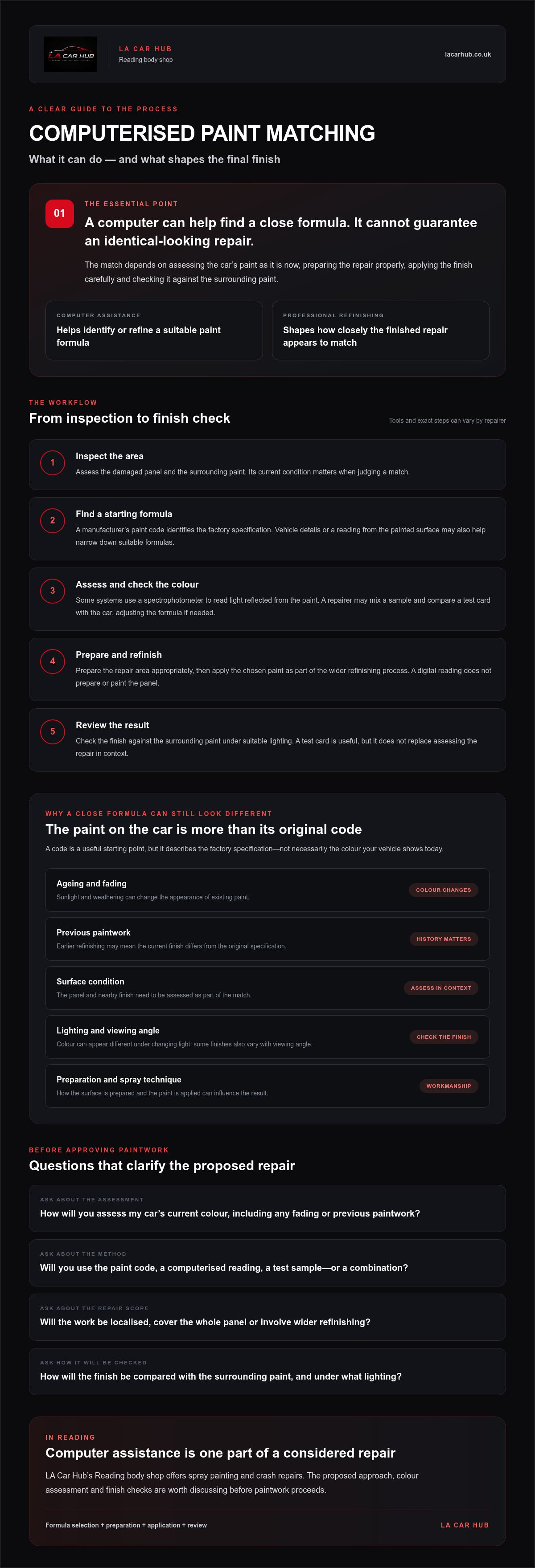
The process combines digital assistance with a repairer’s judgement. Computer assistance can help a repairer select and assess paint. It doesn’t prepare the surface, apply the finish or judge the whole repair on its own. Instruments and workflows vary, so ask what steps the repairer would use for your vehicle.
From colour code or surface reading to a paint formula
A repairer may start with the vehicle’s paint code and details, then assess the existing finish to narrow down suitable formulas. Some systems use a spectrophotometer, a device that reads light reflected from a painted surface to help identify colour characteristics. The method depends on the equipment. For a plain-language overview, see how spectrophotometers measure colour.
A digital reading can point towards a formula, but it still needs to be checked against the car. Depending on the process, the repairer may mix a sample and spray it onto a test card. Comparing that sample with the vehicle can help show whether the formula needs adjustment before work moves to the panel. A test card is useful, but it doesn’t replace checking the finish in context.
Why preparation, spraying, and checking still matter
Once a suitable formula has been selected, refinishing involves more than applying colour. The damaged area must be prepared appropriately, and paint needs to be applied consistently. Spray technique and the condition of the surrounding surface can influence the result, particularly on finishes that change appearance with viewing angle or light.
A typical sequence may include:
- Inspect: Assess the affected area and the surrounding paint.
- Find a starting formula: Use the paint code, vehicle details or a surface reading to guide selection.
- Check the match: Compare a sample or test application with the existing finish, where used.
- Prepare and refinish: Prepare the repair area, then apply the chosen paint as part of the wider refinish.
- Review: Check the result under suitable lighting before considering the work complete.
These steps are a guide, not a promise that every body shop follows the same order or uses the same tools. If you’re comparing computerised paint matching services in Reading, ask what equipment is involved, whether a test application is part of the assessment and how the finished panel will be inspected. LA Car Hub’s Reading body shop offers spray painting and crash repairs. You can discuss your paintwork needs and ask how the proposed work would apply to your vehicle.
Why Can a Computerised Paint Match Still Look Different?
A computerised match can help a repairer choose a close paint formula, but it can’t guarantee that the finished panel will look identical to the rest of the car. A formula is a starting point, not the finished visual result.
Paint age, fading, previous refinishing, surface condition, application, lighting and viewing angle can all affect how closely repaired paint appears to match. The repairer needs to consider the vehicle and repair area, not just the reading or paint code.
How paint age and vehicle condition affect the visible colour
Original paint can change in appearance through exposure and everyday use. The amount of change may differ across the car, depending on how each area has been exposed and maintained. Previous repairs can also leave adjacent panels with finishes that don’t quite match. These are factors to assess, not signs that every older car has a colour problem.
Surface condition matters too. Marks, unevenness or differences in the existing finish may affect how new paint sits beside it. A repairer should look at the area and surrounding panels before deciding how to approach the work. If you’re considering computerised paint matching in Reading, ask how the existing finish and any earlier repairs will be taken into account.
When does blending adjacent paintwork help?
Blending means extending new paint into nearby existing paint so the transition between repaired and original areas is less abrupt. It may be suitable where the repairer judges that a local repair could leave a noticeable change, but it isn’t needed for every job. Whether it’s appropriate depends on the colour, condition of the surrounding paint and the repair area.
Light can change what your eye sees. A colour may appear different indoors, outdoors or from another angle, especially when you compare a repaired panel with one beside it. That’s why a repairer should assess the finish under suitable lighting and view it in context, rather than relying only on a computer reading or a quick glance.
Blending can help ease a transition, but it doesn’t remove every possible variation or guarantee an invisible repair. Before approving the work, ask what finish the repairer expects, whether blending is being considered and why it suits your vehicle. A clear explanation should distinguish the formula selected from the appearance they’re aiming to achieve on the car.
What Should You Ask a Reading Repairer About Paint Matching?
A clear explanation should cover more than the equipment used. Before agreeing to paintwork, find out how the repairer will assess your car, which areas they plan to refinish and how they’ll review the result. These questions can help you understand the proposed work without needing to be an expert in paint.
Questions to ask before agreeing to paintwork
Ask the repairer how they’ll compare the existing colour with the surrounding paint. If a test application or sample card is part of their process, ask how they’ll use it to assess the match. You can also ask what preparation and paint application are included, and whether blending into an adjacent panel is suitable for your vehicle. A useful answer should relate to your car’s condition and the repair area, not just describe a general process.
For computerised paint matching, Reading drivers can ask:
- How will you assess the colour and condition of the surrounding paint?
- Will you use a test application or sample to check the proposed formula?
- What preparation, paint application and final checks are included?
- Could blending into an adjacent panel be appropriate, and why?
How to understand the proposed repair and finish
Ask which panel or areas are included in the proposed work. Clarify whether the repair is localised, covers a whole panel or forms part of wider refinishing. Then check that the written estimate describes the same scope you discussed. If anything is unclear, ask for an explanation before approving the work.
It’s also reasonable to ask how the finish will be inspected, including how the repairer will consider the colour in relation to nearby panels. A computer reading alone can’t promise an identical visual match, so look for a candid explanation of what the process can achieve and what factors may affect the result. Before collecting your car, ask how to raise any concerns if something doesn’t look as expected.
Use this short checklist when contacting a body shop in Reading:
- Describe the damage and identify the panel or area involved.
- Ask how colour assessment and paint preparation will be handled.
- Confirm whether the work is localised, panel-based or wider refinishing.
- Check what the estimate includes and how the finished work will be reviewed.
For broader repair considerations, see the car body shop guidance for Reading drivers. If you’d like to discuss paintwork with a local team, contact LA Car Hub about your paintwork needs.
Computerised Paint Matching in Reading: LA Car Hub
LA Car Hub is based in Reading, where its fully equipped body shop offers spray painting and crash repairs. Matching can help inform paint selection, but the repair approach also depends on the damage and the condition of the surrounding finish. A scratch, localised paint damage and accident-related refinishing may each call for a different scope of work.
If your vehicle needs attention after a collision, you can also read about accident repair options in Reading as part of considering what work may be needed. The key is to understand which areas are affected and what the repairer proposes to refinish, rather than assuming every job follows the same process.
When to discuss computerised paint matching with a body shop
It’s worth raising paint matching when damage has marked or removed the finish, or when accident repairs involve repainting a panel. The repairer can assess the affected area alongside nearby paint and explain whether the proposed work is localised, panel-based or part of wider refinishing. Previous repairs and changes to the surrounding paint may also be relevant, so share anything you know about the vehicle’s paint history.
For people searching “computerised paint matching reading”, useful questions include what the assessment will consider, how the repair area will be prepared and how the finish will be reviewed. The aim is a clear discussion of the proposed work and its limitations, not a promise that the repair will be invisible.
A straightforward next step for Reading drivers
When you contact a body shop, describe where the damage is and how it happened. Include your vehicle’s make, model and any paint-code details you can find, though the repairer may need to inspect the car to assess the colour and condition properly. If you have photographs, ask whether they’ll help with an initial discussion or whether an in-person assessment is needed.
Before proceeding, ask what areas are included, how the repair will be carried out and how the finish will be checked. LA Car Hub’s Reading team can discuss the paintwork process and proposed scope with you, without assuming a particular repair is right before considering the vehicle. For a straightforward conversation about your vehicle’s paintwork, Talk to LA Car Hub about your paintwork.
Take the next step with confidence
Computerised paint matching can help a repairer identify a suitable formula, but the finished appearance also depends on the condition of the existing paint, careful preparation and how the paint is applied. A useful next step is to ask what will be assessed, which areas are included and how the proposed finish will be checked.
If you’re considering computerised paint matching Reading, LA Car Hub is a Reading-based automotive centre with a fully equipped body shop offering spray painting and crash repairs. Discussing the damage and your expectations can help clarify whether the proposed work is localised, panel-based or part of wider refinishing. No matching tool alone can promise an invisible repair, so a clear explanation of the process matters.
Share the affected area and your vehicle details, then ask any questions you need before deciding how to proceed. Talk to LA Car Hub about your paintwork and take the next step with a clearer understanding of the work being proposed.
Frequently Asked Questions
What is computerised paint matching on a car?
Computerised paint matching uses digital tools to help a repairer identify or refine a suitable paint formula for a vehicle. It forms part of the assessment and refinishing process, rather than guaranteeing an exact visual match. Selecting a formula is only one stage: the repair area still needs to be prepared, the paint applied and the finished work checked against the surrounding panels.
How does computerised car paint matching work?
A repairer assesses the vehicle and its existing paint, then uses the available information to select a suitable formula. Depending on the process, they may check a test application before preparing and refinishing the repair area. The finished paint is then inspected in context. Methods and equipment vary between repairers, so ask what steps they propose for your car rather than assuming every body shop follows the same workflow.
Can computerised paint matching guarantee an exact colour match?
No. Computerised matching can help a repairer choose a suitable formula, but it can’t guarantee a perfect visual match in every condition. Paint age, previous repairs and application can affect the result, as can lighting and the angle from which you view the vehicle. Ask how the repairer will assess the finished work alongside nearby panels and what factors might influence the appearance.
Does a car’s paint code always identify the right colour?
A paint code identifies the manufacturer’s factory paint specification and gives the repairer a useful starting point. It doesn’t necessarily describe the colour as it appears on the vehicle today. Exposure and previous refinishing can change the visible finish, so the repairer may also need to assess the actual painted surface. The code remains helpful, but it may not be the only information needed to select a formula.
Why can a newly painted panel look different from the rest of the car?
A new panel may appear different because the original paint has aged, the surrounding finish has a different condition or a previous repair changed its appearance. Application also affects the result, while lighting and viewing angle can make colour differences easier to notice. A repairer can assess whether blending new paint into adjacent areas is suitable. Blending may ease a transition, but it can’t promise to remove every visible variation.
How long does computerised paint matching take?
There’s no single standard duration for computerised paint matching. It’s one part of a wider repair, and the overall timing depends on the damage, preparation required, paintwork and the repairer’s process. A small area of paint damage may involve a different scope from accident-related refinishing. Ask for an estimate of the full job after the vehicle has been assessed, and clarify what that estimate includes.
Where can I get computerised paint matching in Reading?
LA Car Hub is a Reading-based automotive centre with a fully equipped body shop offering spray painting and crash repairs. If you’re searching for “computerised paint matching Reading”, describe the damage and share your vehicle details when making an enquiry. Ask how the paint and surrounding area will be assessed, what work is proposed and how the finish will be checked. The repairer can explain the process and scope after considering your vehicle.


